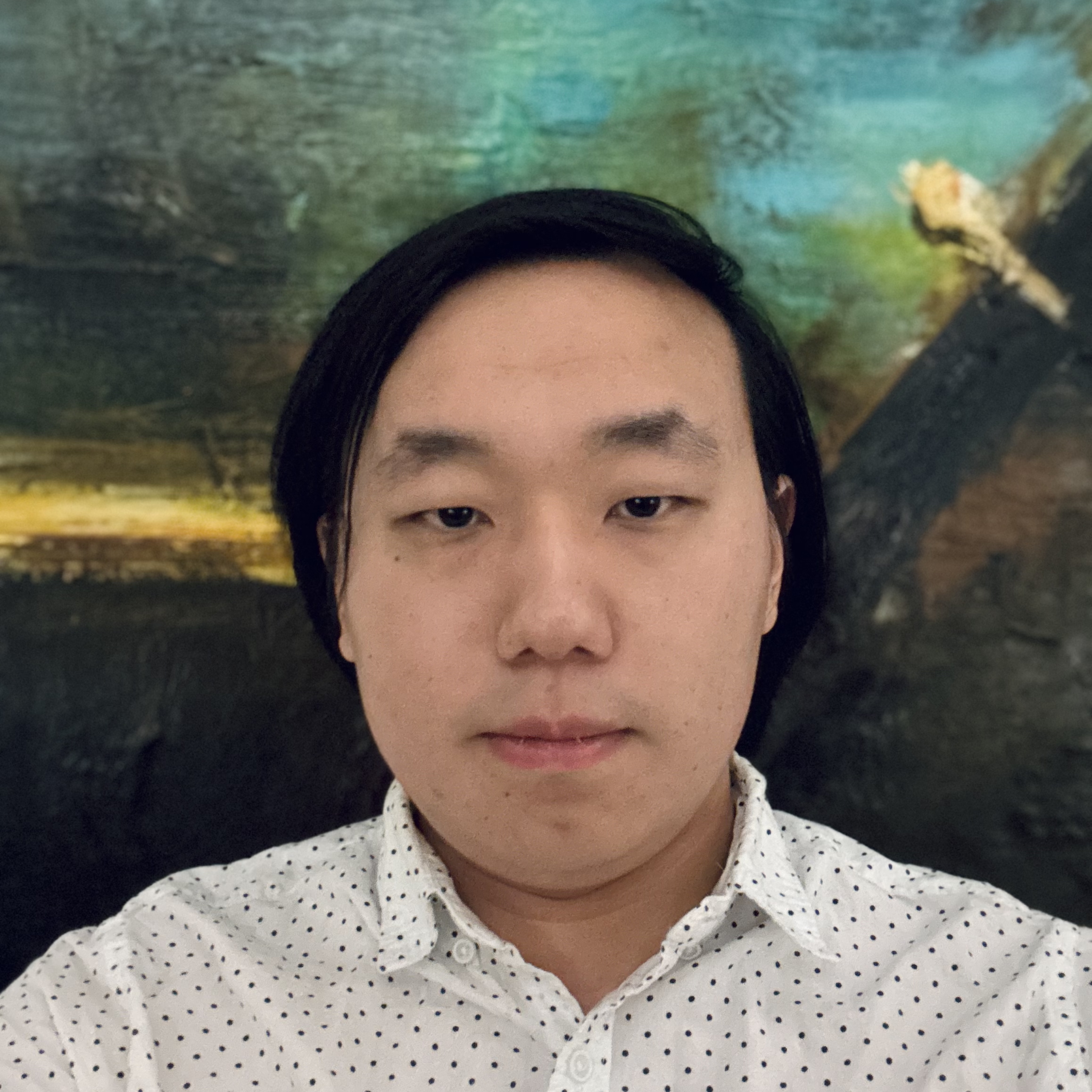
Portrait of Eric Li

Eric Li

I am a PhD student at MIT CSAIL, where I work with Bill Freeman and Josh Tenenbaum. Before MIT, I studied EECS at Berkeley and worked on computational imaging with Laura Waller and quantum computing with Alp Sipahigil.

I study visual perception and physical reasoning, using probabilistic programming and machine learning to construct structured 3D representations of the physical world that support boundedly rational decision-making. My interests are in understanding how human-level visual scene understanding emerges from the combination of rich symbolic structure and learned features, and in formalizing the computational principles that govern how agents perceive, reason, and act in the physical world.

If you're also interested in visual perception, physical reasoning, probabilistic programming, or Bayesian modeling, please send me an email! If you're considering grad school and aren't sure about how the process works, or just want to talk to a current grad student to see if it's right for you, consider checking out the MIT EECS Graduate Application Assistance Program (GAAP).

Research

Selected papers, ordered roughly by relevance to my current work.

Visual Perception and Physical Reasoning

GenMatter: Perceiving Physical Objects with Generative Matter Models
Eric Li, Arijit Dasgupta, Yoni Friedman, Mathieu Huot, Vikash Mansinghka, Thomas O'Connell, William T. Freeman, Joshua B. Tenenbaum
CVPR 2026

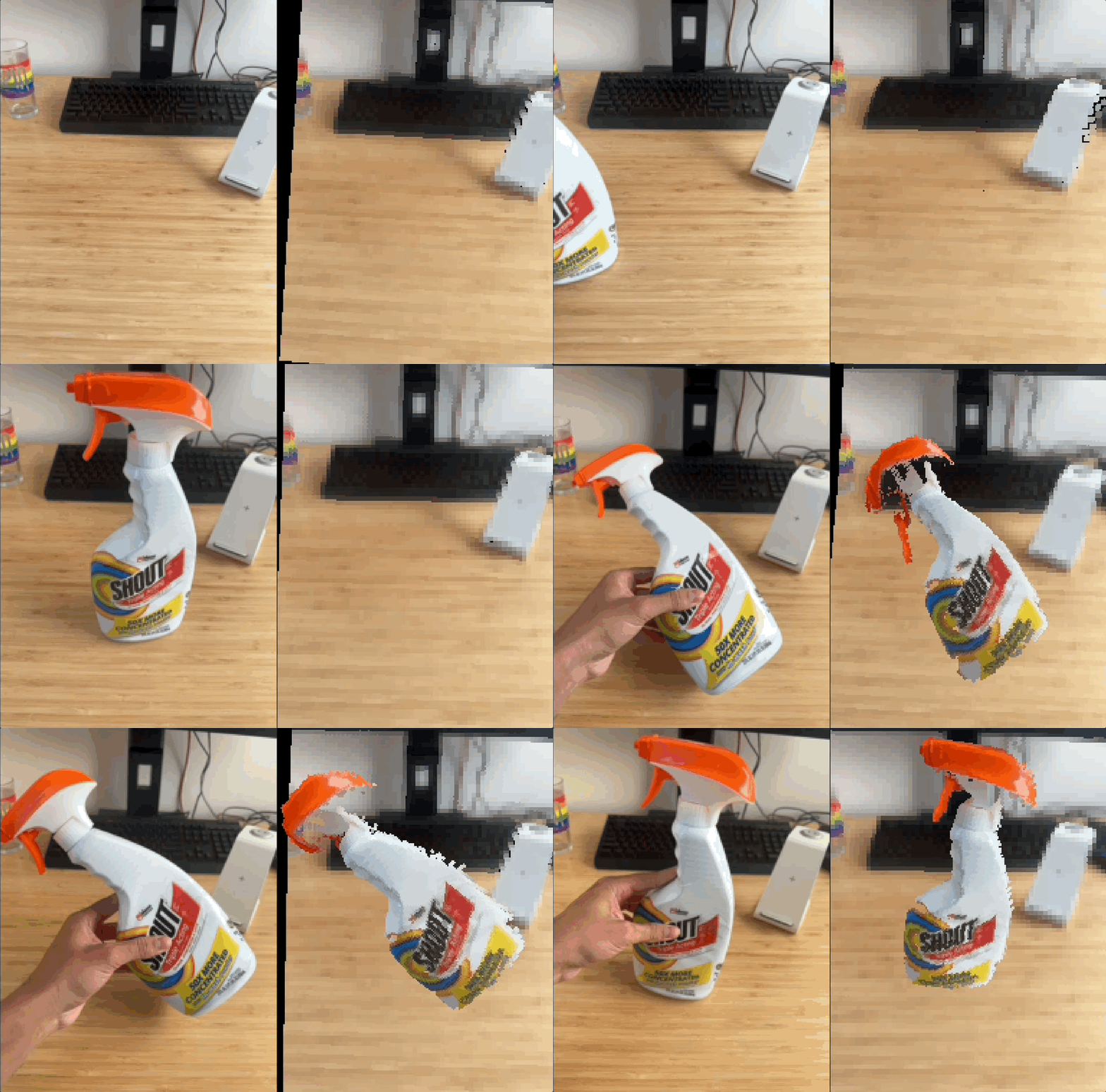
A generative model of moving matter that groups motion and appearance cues into particles and clusters, supporting motion-based perception across random dots, camouflaged structure-from-motion scenes, and naturalistic RGB video.

Bayes3D inference animation
Bayes3D: fast learning and inference in structured generative models of 3D objects and scenes
Nishad Gothoskar*, Matin Ghavami*, Eric Li*, Aidan Curtis, Michael Noseworthy, Karen Chung, Brian Patton, William T. Freeman, Joshua B. Tenenbaum, Mirko Klukas, Vikash K. Mansinghka
arXiv, 2023

An uncertainty-aware perception system for structured 3D scenes, using a hierarchical Bayesian model and GPU-accelerated inference to learn novel objects from a few views and infer object pose and scene composition in clutter.

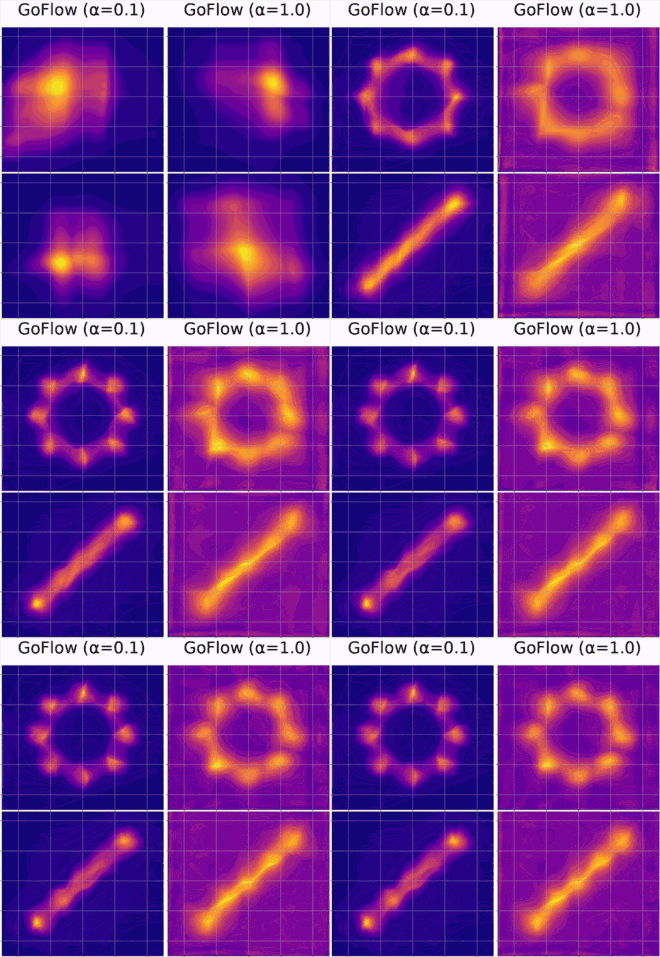
GOFLOW skill learning animation
Flow-based Domain Randomization for Learning and Sequencing Robotic Skills
Aidan Curtis, Eric Li, Michael Noseworthy, Nishad Gothoskar, Sachin Chitta, Hui Li, Leslie Pack Kaelbling, Nicole E Carey
ICML, 2025

A learned domain-randomization method for robotic reinforcement learning, using normalizing flows to model flexible simulation distributions that train robust skills and serve as uncertainty-aware artifacts for multi-step manipulation planning.

Computational Imaging

Quantum Computing

Observation of interface piezoelectricity in superconducting devices on silicon
H. Zhou, Eric Li, K. Godeneli, Z. H. Zhang, S. Jahanbani, K. Yu, M. Odeh, S. Aloni, and others
Nature Communications, 2025

Identifies interface piezoelectricity as a decoherence channel in silicon-based superconducting quantum processors, showing that aluminum-silicon interfaces can convert microwave energy into acoustic loss and limit qubit quality factors.

Non-Markovian dynamics of a superconducting qubit in a phononic bandgap
M. Odeh, K. Godeneli, Eric Li, R. Tangirala, H. Zhou, X. Zhang, Z. H. Zhang, and others
Nature Physics, 2025

Uses phononic-bandgap engineering to protect a superconducting qubit from defect-mediated phonon loss, reshaping its dissipative environment and pointing toward smaller, longer-lived qubits for quantum processors.